Understanding the Indian Toner Cartridge Market
Growth Drivers and Market Demand
India’s office landscape runs on printed paper more than most people realize. Monthly print volumes across Mumbai’s financial districts and Johannesburg’s corporate hubs tell different stories, yet both rely on consistent supply chains. The demand for a toner cartridge manufacturer in India has climbed steadily because local production cuts lead times and lowers logistics friction for South African importers.
Several forces drive this expansion:
- Rising small business formation across Indian metro areas
- Frequent OEM cartridge replacements that push buyers toward compatible options
- Export incentives that make Indian facilities attractive partners
The market now rewards manufacturers who maintain strict quality control while scaling output. A toner cartridge manufacturer in India that invests in precision assembly can serve both domestic distributors and international buyers without compromising on page yield. That reliability matters when your office depends on uninterrupted printing, and frankly, it sets Indian producers apart in a crowded field.
Key Players and Competitive Landscape
The Indian toner market is not a single entity. It is a spectrum, from large scale operations with clean rooms to small workshops with questionable output. For a buyer in Johannesburg, the difference is not academic. A toner cartridge manufacturer in india that prioritizes traceability will often outperform one that competes only on price.
What separates the leaders? Mostly their attitude toward failure. They treat a defective batch as a systemic problem, not an accident. They invest in testing equipment and skilled labor. Others take shortcuts, which shows up as inconsistent page yields and leaking cartridges.
When evaluating suppliers, consider these signals:
- Whether they openly share their quality control processes
- Whether they have export documentation in order
- Whether they can handle order volumes without panic
That last point reveals a lot about a company’s internal culture. The competitive landscape among any toner cartridge manufacturer in india rewards those who treat printing as a precise discipline, not an afterthought.
Regulatory and Environmental Considerations
India generates over 3.2 million tonnes of e-waste annually, and toner cartridges account for a notable slice of that pile. This explains why a serious toner cartridge manufacturer in india must follow a maze of rules that would test a bureaucrat’s patience. The Central Pollution Control Board enforces Extended Producer Responsibility, which means the maker is accountable for the cartridge’s entire life cycle. That includes takeback programs and recycling quotas; this is non-negotiable.
For a buyer in Johannesburg, these regulations matter more than you might expect. A manufacturer who treats compliance as a joke will likely cut corners on export quality as well. It pays to look for evidence of registration numbers and audit reports.
- RoHS compliance restricts hazardous substances in the cartridge
- Plastic waste management rules govern packaging materials
- E-waste handling authorisation from local authorities
Some Indian manufacturers treat these environmental obligations as a chance to refine their operations. They produce cartridges that meet global standards, giving buyers a reliable signal that the factory runs with discipline, not chaos.
Consumer Preferences and Buying Patterns
Indian consumers, from Mumbai print shops to Delhi corporate offices, measure a cartridge by its cost per page, not its sticker price. They know that the cheapest toner cartridge manufacturer in india may not deliver the lowest operating cost. This has created a buying pattern where buyers scrutinise page yields and failure rates before committing to a brand.
Brand loyalty is weak in this market. A shift in price of even a few rupees sends procurement managers to alternative suppliers. They also watch for counterfeit products, which remain a persistent nuisance. Buyers often demand to inspect the packaging seals and batch codes before purchase.
- Compatibility with existing printer models is the first filter.
- Delivery speed within tier two cities is the second consideration for many businesses.
Online marketplaces have altered behaviour, allowing side by side comparisons of third party and original cartridges. Yet, many buyers still prefer a local dealer who can handle warranty claims without postal delays.
Types of Toner Cartridge Manufacturing Processes
OEM vs Compatible vs Remanufactured
Few decisions shape print quality more than the manufacturing path behind each cartridge. A toner cartridge manufacturer in India can produce units from scratch, reverse-engineer them to match brand specifications, or restore empty cartridges to full function. Each method carries its own trade-offs between cost and reliability.
- OEM cartridges are built in the same factories as the printer brands, using original molds and firmware.
- Compatible cartridges are crafted by third parties to meet similar performance, though they may lack the original chipset.
- Remanufactured units are cleaned, inspected, and fitted with new components until they work like new.
Selecting among these routes changes your cost per page and how often you replace a cartridge. It also determines whether your printer recognizes the toner and reports accurate levels.
Raw Materials and Key Components
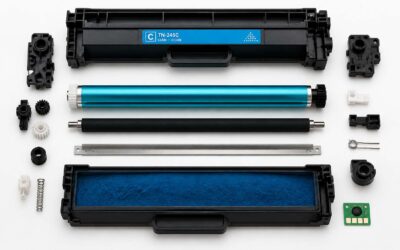
The sequence inside any toner cartridge manufacturer in india follows a fixed rhythm. Plastic granules melt into steel moulds, forming shells that move down the line. Workers then install the developer drum, springs, and seals before the toner powder is added.
The powder itself contains styrene acrylic copolymers, carbon black, and iron oxide, ground to a precise grit. Shells are usually high impact polystyrene. The drum is aluminium with a rubber coating. The chip set, however small, is what lets the printer recognise the cartridge.
- Toner powder that transfers at the right charge
- Separate colour blocks for cyan, magenta, yellow, and black
- An RFID chip that reports toner levels
- Foam seals that block moisture
Raw materials for a toner cartridge manufacturer in india are not uncommon, but the quality of the blend decides whether prints come out clean or streaked. That is why so much attention lands on the mixing room.
Quality Control and Testing Standards
Manufacturing processes split into two camps: mono component and dual component. Mono component systems fuse toner directly onto the drum. Dual component systems rely on a magnetic carrier to transport the powder. Both require clean rooms, static controlled floors, and precise humidity levels. Semi automated lines handle most assembly work.
Quality control separates reliable products from failures. Every batch from a toner cartridge manufacturer in india goes through yield testing, print density checks, and fusing tests. Cartridges that drop below 98 percent of rated page output are pulled. Drop tests mimic rough freight handling. Humidity chambers verify foam seals stay intact.
- Charge consistency across the drum surface
- Toner particle size, measured in microns
- Contact resistance on the chip connector
Export focused facilities adopt ISO 9001 and 14001 standards to satisfy South African buyers. Those certifications demand documented traceability. Each test adds cost, but it protects the brand in a competitive export market.
How to Evaluate a Toner Cartridge Manufacturer in India
Certifications and Compliance
Evaluating a toner cartridge manufacturer in india demands more than a glance at their brochure. Certifications can impress, but only if they are real. One company proudly displayed an ISO 9001 award that covered, it turned out, only their office furniture. True compliance means traceable credentials. Environmental clearances and substance restrictions such as RoHS and REACH should be unambiguous. A manufacturer who cannot explain these standards likely cannot meet them.
Watch for these compliance pitfalls during your assessment:
- Certificates without a matching serial number on the registrar’s website
- Auditing bodies with no accreditation history
- Material data sheets that omit toner composition details
Regularly, the final proof sits in the audit trail. A toner cartridge manufacturer in india with credible certifications will let you inspect those records. One without them will suddenly find a scheduling conflict. Most manufacturers will hand you a story; only a few will hand you the paperwork.
Production Capacity and Scalability
There is a particular silence in an underused production hall. For any toner cartridge manufacturer in india, that silence is expensive. South African buyers should measure capacity in actual monthly output, not in advertised machine counts. Ask what happened when their biggest client doubled an order. The answer will reveal more than any brochure.
Scalability demands infrastructure. A manufacturer who has never scaled will not know their own limits.
- Monthly output in units, broken down by product line
- Peak historical production volume in a single quarter
- Number of shifts and the state of raw material inventory
A toner cartridge manufacturer in india who treats expansion as routine will let you inspect the floor, the stock, and the dispatch records. The others offer coffee and a short tour.
Pricing and Bulk Order Terms
Whenever you sit down with a toner cartridge manufacturer in india, the price list is only the beginning. The real conversation starts when you ask about bulk order terms. I have seen buyers focus on the unit price and miss the freight, the packaging, and the credit period.
Ask for a breakdown of costs across order sizes. A reliable manufacturer will show a sliding scale without hesitation!
- Minimum order quantity and its effect on unit price
- Payment terms, including any advance percentage
- Lead time for production and dispatch
- Penalty clauses for delayed shipments
Then check whether the quoted tone is firm or negotiable. A toner cartridge manufacturer in india who locks in pricing for six months is worth more than one who offers a tempting discount for a single order.
Distribution and Supply Chain Capabilities
I have seen too many buyers overlook distribution until a crisis hits. A single delayed shipment can stall a Johannesburg office for days. That is why supply chain reach deserves your attention! When evaluating a toner cartridge manufacturer in india, ask how they manage inland logistics after the port. Do they maintain warehousing near Durban or Cape Town?
- Request proof of their tracking systems for real-time updates
- Ask about buffer stock for urgent reorders
- Verify experience with South African customs clearance
A manufacturer with direct shipping partners offers more reliability than one relying on third-party brokers. Look for evidence of regional distribution networks. The real test is how they respond to disruptions. Their ability to reroute shipments quickly reveals true capability.
After-Sales Support and Warranty
When a cartridge fails mid quarter, your after sales support and warranty terms decide the cost of downtime. When evaluating a toner cartridge manufacturer in india, ask for their warranty response protocol in writing. Many promise twelve months, but the real test is the first ninety days. Do they offer advance replacement for dead on arrival units or expect you to pay return freight?
Check for a local support presence in South Africa. A Johannesburg based technician who troubleshoots over video beats a distant call centre every time.
- Confirm the mean time to respond for claims.
- Clarify who pays return shipping.
- Ask for client references who filed claims.
A reliable toner cartridge manufacturer in india treats warranty as a product feature. Their willingness to diagnose remotely and replace quickly reveals engineering confidence. Pick one who answers before your printer runs dry.
Technological Capabilities and Innovation
Print chemistry evolves quietly. A toner cartridge manufacturer in india that wins long term contracts usually competes on formulation science, not glossy brochures. Particle size distribution is the controlling variable. Milled toner resin that varies by even a micron changes transfer efficiency, which changes print density on a Johannesburg production floor.
The best facilities run air classification systems and spectroscopic analysis on every batch. They publish melt flow profiles. They maintain environmental chambers that simulate Durban humidity and Highveld winter conditions. I have seen volume chasers hide their process charts entirely.
Evaluate their innovation pipeline:
- Does their formulation unit hold patents on charge control additives?
- Do they engineer custom dewaxed toner for high speed printers?
- Can they document laser absorption consistency across paper stocks?
A toner cartridge manufacturer in india without laboratory depth is merely blending pigment and polymer. The technology tells the truth.
Leading Manufacturing Hubs and Technologies
Major Industrial Clusters
In the industrial corridors of Noida and Greater Noida, a toner cartridge manufacturer in india achieves output volumes that would baffle a 1980s factory floor. These clusters run injection molding machines at cycle times under thirty seconds, followed by automated assembly lines that fit drums and wipers without human touch. Pune and Chennai balance the geography, with Chennai offering port access for bulk exports.
- Noida: precision plastic molding and laser welding
- Pune: high speed cartridge assembly and automated inspection
- Chennai: export oriented production with containerized logistics
Each hub invests in ultrasonic sealing and vacuum testing technologies to ensure cartridge integrity. When you evaluate a toner cartridge manufacturer in india, these local technological capabilities determine whether your supply chain runs smoothly or stalls. For South African importers, this means shorter lead times and fewer defective units.
Automation and Precision Engineering
In Noida, the modern toner cartridge manufacturer in india runs injection molding machines at cycle times under thirty seconds. Automation handles the repetitive work. Precision sensors examine every seam, and ultrasonic sealing closes the cartridge with quiet certainty. The result is a component that behaves predictably from factory floor to office printer.
Engineers in Pune tune robotic arms for high speed assembly. They measure torque, alignment, and pressure with calibrated instruments. Chennai adds a maritime advantage, where containerized logistics move production runs directly onto vessels bound for Durban or Cape Town.
Some facilities use:
- Robotic guided vehicles moving cartridges between stations
- Vacuum testing chambers that reject even a pinhole leak
- Laser etching for batch traceability
One plant manager mentioned that his machines have better attendance than most humans. He may well be right.
Sustainable Manufacturing Practices
Gujarat’s chemical corridor supplies raw polymers to cartridge plants, while Bengaluru’s tech ecosystem provides firmware engineers who adapt chip sets for new printer models. The result is a manufacturing base that spans polymer chemistry, embedded systems, and logistics.
Sustainable practices are not an afterthought. A toner cartridge manufacturer in india may run injection molding halls on rooftop solar arrays, redirect excess heat into curing ovens, and wash components with recycled water.
Closed-loop plastic regeneration turns scrap housings into new components. Low-energy curing seals toner without excessive heat. Reverse logistics bring used cartridges back to the factory. One facility in Pune reports a 40 percent drop in water usage through closed cooling loops.
Logistics and Export Readiness
The geography of production shapes the cadence of trade. In Gurugram, assembly lines hum through the night, converting imported drums into finished cartridges by dawn. Chennai’s factories sit minutes from the docks, so a toner cartridge manufacturer in india can pack an order for Durban and have it aboard a vessel the same afternoon.
That proximity to sea routes creates an export rhythm few competitors match. Mundra and Nhava Sheva move container traffic with quiet efficiency, while bonded warehouses in Dubai and Singapore let a toner cartridge manufacturer in india stage inventory closer to African buyers.
The logistics mix varies by urgency:
- Air freight for urgent OEM replacements
- Sea freight for standard compatible volumes
- Rail-linked container movement for inland hubs
Each lane is priced and timed with precision, which matters when a Johannesburg reseller needs stock within ten days.
Future Trends and Opportunities
Shift Towards Remanufacturing and Circular Economy
Over 300 million cartridges are discarded every year, and only a fraction return to production lines. A toner cartridge manufacturer in India that pivots to remanufacturing can change that equation. The circular economy is not an abstract ideal; it is a procurement requirement. South African importers increasingly audit suppliers for closed loop practices, and those who recover cores from the field gain a cost advantage.
A typical remanufacturing line can reclaim 70% of a cartridge’s mass. The profitable opportunities are specific:
- Plastic housing regrinding
- Toner reservoir deep cleaning
- Roller and gear replacement
Each step demands separate testing protocols. A toner cartridge manufacturer in India that masters this workflow can sell into markets with aggressive e-waste laws while lowering per unit material expenses.
Impact of Digitalization and E-Commerce
Digital procurement platforms are rewriting how South African businesses source supplies. A toner cartridge manufacturer in india now needs a visible online catalog, real time inventory updates, and direct ordering systems. Buyers in Johannesburg or Cape Town expect the same digital convenience they get from local suppliers. I have seen importers walk away from a deal simply because the ordering portal was clunky.
Orders that once required email chains and proforma invoices now move through B2B marketplaces. Some manufacturers are experimenting with:
- API based stock syncing for distributor portals
- AI driven order routing to reduce lead times
- Digital warranty registration for remanufactured lines
These tools speed up order cycles from factory floor to foreign buyer. A toner cartridge manufacturer in india that invests in these systems gains preference among importers who value speed and traceability.
Emerging Export Markets and Partnerships
The next decade will shift trade flows. Indian toner manufacturers are no longer waiting on the United States or Europe. They are turning toward Nigeria, Kenya, and Ghana, where office infrastructure is growing rapidly yet local cartridge production remains thin. That gap creates room for Indian suppliers offering predictable quality and consistent supply.
Partnerships will shift shape. Joint ventures with African distributors are becoming more common than simple buyer seller relationships. A toner cartridge manufacturer in india might co-develop private label products with a regional partner, sharing technical knowhow and market access. This model reduces friction and builds loyalty. A toner cartridge manufacturer in india that invests in local African warehousing can cut delivery times dramatically.
Watch this! Regional trade blocs are harmonizing import rules.
- SADC is streamlining customs documentation.
- COMESA is easing rules of origin.
- ECOWAS offers a unified tariff schedule.
Manufacturers who map those regulations early gain an edge.

0 Comments